



If you have not already read the general guidelines for using the topical guides, please begin here. As a reminder, these guides are intended to stir your initial thinking, not offer comprehensive guidance. We encourage you to explore the questions and resources in this guide with at least one other person on your campus.
Introduction
Belonging initiatives go by a range of names on various campuses: diversity, equity, inclusion, justice, belonging, and flourishing—or some combination of those. On many campuses, these initiatives are administered and delivered separately from vocation and calling initiatives. However, these initiatives are organic partners to vocation because they both relate to whole-person questions of identity and personhood, growth and development, community and connection, civic access and participation, and what is possible for our students’ lives. Moreover, institutional commitments to student belonging and flourishing and to vocational frameworks both tend to flow from institutional mission, which gives the private colleges and universities among NetVUE’s membership firm grounding in their institutional purposes and aims.
The language of “Belonging and Flourishing” speaks to the ultimate outcome we wish for students. Awareness of and attention to inclusive and equitable practices ideally permeates every component of the student experience, from academics to residential life to co-curricular activities of every kind. This requires comprehensive institutional commitment in the form of thoughtful, integrated structures, policies, and programming as well as ongoing professional development for every educator on campus. With patience, care, and accompaniment by expert consultants though, campuses can implement structures, policies, and practices that promote belonging and flourishing as a vital element of vocational discernment and exploration.
Questions to Consider
- How are belonging and flourishing commitments (under whatever language your institution uses) made concrete on your campus? Where are initiatives or programs clearly making a difference in students’ experience of your college or university? Where do you see obvious gaps?
- How do commitments to belonging and flourishing (again, under whatever language your institution uses) connect to your institution’s stated mission and/or current strategic plan? Is this connection explicit or implicit on your campus?
- Does your campus explicitly link belonging and flourishing to vocation? If so, how and where do you see areas for growth? If not, where do you see points of connection that might be developed?
Resources
Blog Post
The Power of Proximity
by Esteban Loustaunau
Inspired by Bryan Stevenson’s Just Mercy, Spanish professor and community-engagement educator Loustaunau suggests that genuine proximity to those who are marginalized and silenced is itself a vocational summons, one that dissolves the barriers separating us, not only from our neighbors, but also from our deeper selves. His own programmatic work on his campus has illuminated how structured, intentional encounters with community develop in students the belonging and self-awareness that vocational discernment requires. He challenges readers to consider that whole-life calling cannot be fully discerned from a comfortable distance.

Blog Post
Our Students’ Vocations and the Gift of (Un)Gendered Language
by Kiki Kosnick
This post suggests that gender justice in and through language is not a peripheral concern but a fundamental dimension of vocation. Moreover, how institutions speak (or fail to speak) shapes which students feel fully seen as bearers of callings. Kosnick both advocates for inclusive pedagogical practices and introduces nuance by critiquing reflexive approaches like compulsory pronoun-sharing, which can inadvertently place the burden of inclusion on the very students most vulnerable to it. Kosnick invites all faculty, regardless of their own identities, to deepen their fluency in gender and sexuality as they accompany students in discernment.
Blog Post
Vocation and Diversity: Some Institutional Considerations
by Florence Amamoto
This post argues that institutions who are serious about vocation must be equally serious about inclusion—and that students of color, first-generation students, and other underrepresented populations cannot fully explore their callings on campuses where they do not feel seen or supported. The work of vocational formation is therefore inseparable from the work of equity. Amamoto offers concrete, practitioner-level observations from her own campus, illustrating how small institutional choices can shape the vocational imagination for students already navigating additional barriers.
Podcast Episode
Change Maker
with Abel Chávez
Chávez sees our callings through this important question: what type of ancestor do we want to be? He explores the contours of our vocations as change makers in our careers and in our communities. Drawing from his experience with Hispanic Serving Institutions (HSIs), Chávez discusses how we can best serve first-generation students: inviting them to explore new pathways and experiences so that they can return to their home communities to provide leadership. This podcast reminds us that education has an obligation to engage with the challenges and structures in civic life to improve them for the benefit of all.

Podcast Episode
Attention and Contradiction
with Willie James Jennings
Public theologian Willie James Jennings believes that belonging is the goal of education, which is pursued at the intersections of the world’s contradictions and our own social and moral sensibilities. In this conversation, he reflects on the influence of mentors and role models while also highlighting the racialized and unjust structures within Western educational systems. He encourages educators to listen to, learn from, and (above all) pay attention to their students as part of a shared vocational process.
Example Activity
Below is an example of an activity that welcomes all students into a conversation about vocation. This activity is meant to be an example to spark thinking about what might be possible in your classrooms and programming.
NetVUE Conversation Cards: Encuentra
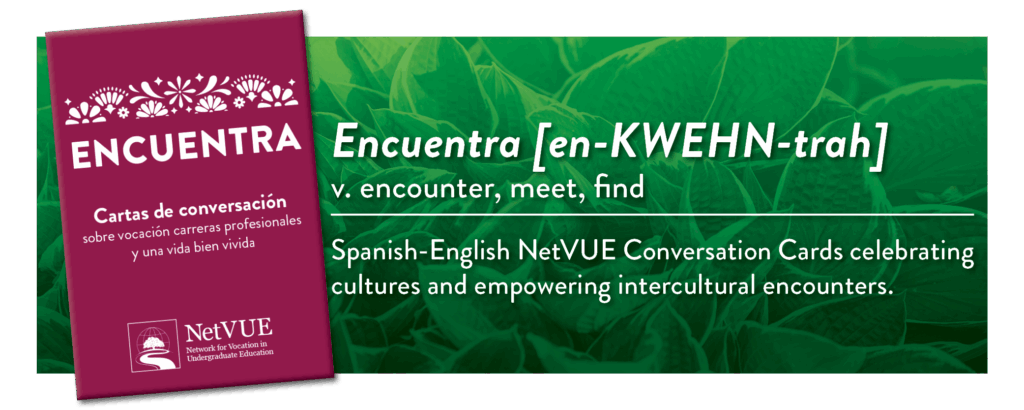
Promoting belonging and flourishing among students of diverse backgrounds needs to be handled with self-awareness, care, and intention. But it does not have to be ambitious or complicated; sometimes simple is powerful. We recommend our very own Encuentra NetVUE Conversation Cards, designed to help all students, no matter their background, reflect on how their cultural contexts have shaped who they are. The cards dance between particularity and universality, foregrounding and celebrating the experiences of Hispanic and Latine peoples, while inviting everyone to consider their cultural shaping. Many of the questions encourage storytelling, which allows students to share about personal experiences and the richness of their families, communities, and cultures. The linked website, along with the main NetVUE Conversation Cards webpage, provides activity guidelines and suggestions.
Back to NetVUE Topical Guides
To report a technical problem with the website, or to offer suggestions for navigation and content issues, please contact Alex Stephenson, NetVUE communications coordinator, at astephenson@cic.edu.