

This annual report captures a year in which CIC continued to listen to members and act quickly upon what we heard. The 2025–26 year was challenging for higher education. Changes in government and society ripple outward to affect everything from institutional policies to curriculum, funding, and student support. Yet CIC members are meeting these challenges head-on as they adapt and evolve to support students.
Over the past year, CIC offered new and relevant programs and resources to stay at the forefront of the sector, promote inclusive pathways to academic leadership, respond to our members’ needs, and support more and more varied campus roles. We invite you to review the report, learn how you and your peers have driven independent higher education onward, and reflect on how the work we do together can continue to support you.
In support of CIC’s three-tiered mission, CIC follows four strategic priorities:
- Ensure our institutes, leadership development programs, workshops, and conferences are ever more relevant, engaging, inspiring, and of practical use.
- Support member financial health and innovation.
- Increase member engagement.
- Strengthen CIC’s role as a visible champion of independent higher education.
“This annual report captures a year in which CIC continued to listen to members and act quickly upon what we heard.”
Marjorie Hass, President, CIC
CIC Networks
AI Ready
CIC’s AI Ready network provides institutions with structured, expert-led professional development across all campus roles—from faculty and staff to senior leadership—helping everyone understand and effectively implement AI in their specific contexts. The 12-month network offers practical, action-oriented programming designed to help institutions move from AI conversation to actual adoption.
The 2025–26 network included:
- Program 1: All Campus Essentials (an opportunity to learn about and engage with nine pressing topics)
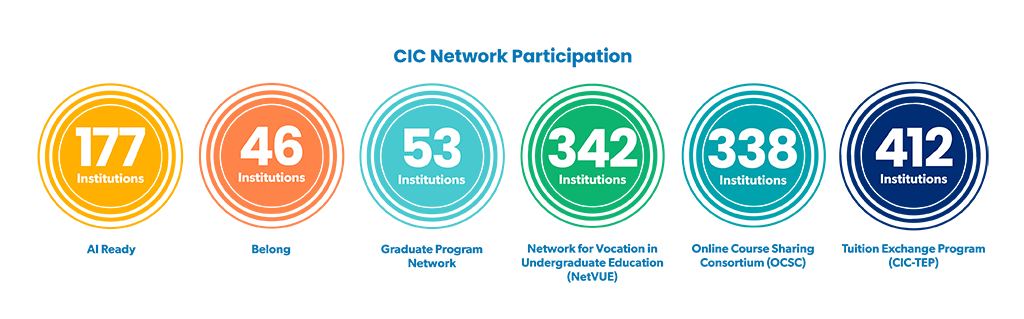
- Members in 2025–26 Cohort: 160
- Program 2: Building and Launching Together (a small, space-limited, pilot program for institutions ready to implement generative AI on campus)
- Members in 2025–26 Cohort: 39
Looking Ahead: Year three of AI Ready will launch in September 2026, this year in partnership with Google for Education, with three programs:
- All Campus Essentials (an opportunity to learn about and engage with nine of the most pressing AI topics over 12 months, structured so all areas of campus benefit and participate consistently)
- Leading the AI Charge (a monthly working community for campus leaders driving AI adoption, where the conversation moves from what AI is to what your institution does next)
- Bot Building Cohort Sprints (3-week sprints for the super users on your campus to apply and advance their skills using AI tools)
Belong: An Inclusive Learning Community
The Belong community is a network of CIC members dedicated to making their campuses more welcoming and inclusive. Belong’s suite of professional development resources for faculty and staff includes microcredentials by CIC, all campus Cornerstone Webinars, Belong’s unique and popular “Push” resource library, and monthly community of practice meetings.
- Network Contributor Members: 46
- Credentials Issued to Belong Members: 983
- Faculty and Staff Webinar Registrants: 1,572
Graduate Program Network
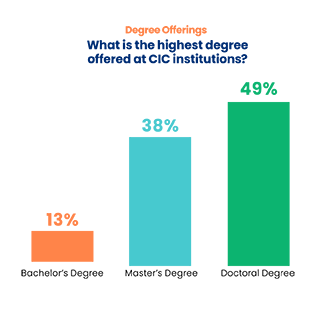
In March 2026, CIC launched the Graduate Program Network for those who develop and manage graduate degree programs on our member campuses. More than three-quarters of CIC member institutions now offer graduate programs, which are often critical to their survival. The new network offers an exclusive community where senior administrators can tackle shared challenges, co-create practical solutions, and shape the future of graduate education at independent institutions. The network provides a space for them to connect with peers and share best practices. The goal is to help independent colleges launch and sustain graduate programs that are efficient, effective, and excellent. The network’s opening programming, which will run through the 2026–27 academic year, focused on graduate education’s current landscape and the shifting marketplace of new graduate programs.
- Members: 53
Network for Vocation in Undergraduate Education (NetVUE)
NetVUE is a nationwide network of nearly 350 colleges and universities formed to support and enrich vocational exploration and discernment among undergraduate students. Activities include a biennial national conference, regional gatherings, faculty seminars, campus visits and consulting services, online resources and networking, and the development of scholarly resources. NetVUE also offers grants to member institutions to support professional development and vocation-related programming.
- NetVUE Institutional Members: 342
- NetVUE Organizational Members: 14
Regional and Topical Gatherings
NetVUE campus teams gather regularly for professional development and sharing of best practices at regional and topical gatherings throughout the year.
- “The Purposeful University”
- Date: October 2–4, 2025
- Location: Bushnell University (OR)
- “Scriptural Reasoning and/as Vocational Discernment: An AAR/SBL Pre-Meeting”
- Date: November 20–21, 2025
- Location: Boston, MA
NetVUE Online Resources
CIC provides a wide range of online resources for NetVUE members, including a dedicated website, an online community site, a publicly accessible blog, a webinar series, and a social media presence.
- LinkedIn
- NetVUE (Network for Vocation in Undergraduate Education): 1760 followers
- Blog
- VocationMatters.org
- Podcast
- “Callings: Conversations on College, Career, and a Life Well-Lived”
- Season 5 (2024–25) 11 episodes
- Season 6 (2025–26) 10 episodes as of June 30, 2026
- “Callings: Conversations on College, Career, and a Life Well-Lived”
- Periodic Webinars
- “NetVUE Big Read Webinar: Exploring Our Callings to Higher Education” (September 2025)
- “Scriptural Reasoning for Vocational Reflection” (October 2025)
- “Using Follow Your Bliss and Other Lies About Calling in the Classroom” (November 2025)
- “The Big Read: Exploring Studies in Vocation and Diverse Perspectives & Vocational Reflection” (January 2026)
- “Vocation and Character” (February 2026)
- “(Re)Experiencing the NetVUE 2026 National Conference” (April 2026)
- Newsletter NetVUE Connections
- September 4, 2025
- October 16, 2025
- January 21, 2026
- April 9, 2026
NetVUE Grant Programs
- Program Development Grants
- CIC awards grants to strengthen existing vocational exploration programs that are already supported by campus budgets. Member institutions may request up to $100,000 for use over a two-year period to further develop or extend existing initiatives.
- 2026: $1,375,596 to 30 institutions
- Cumulative: $13,330,858 to 290 institutions
- Professional Development Awards
- CIC awards grants of up to $20,000 to enhance the knowledge, skills, and expertise of faculty and staff members who support undergraduate vocation-related initiatives at NetVUE member institutions. Up to $25,000 is available for projects with a special focus on diversity, equity, and inclusion.
- 2025: $829,018 to 43 institutions
- Cumulative: $3,398,049 to 287 institutions
- Vocation across the Academy
- This grant program is designed to strengthen the link between professional preparation and students’ exploration of meaning, purpose, and identity. Three-year grants support campuswide initiatives that emphasize this link as a continuum from the first year through the senior year, and/or across the range of academic disciplines and applied fields.
- The grant involves a partial donor match that can bring the total award to $195,000 in CIC and third-party funding, or $225,000 for projects that create partnerships with businesses, nonprofits, and community organizations.
- 2025: $354,913 to 5 institutions
- Cumulative: $3,985,918 to 91 institutions
- Grants for Reframing the Institutional Saga
- This program offers grants of up to $60,000 over three years to help institutions produce an updated account of their history and mission, with focused attention on the current state of the institution’s demographic profile, surrounding community, and founding organizations.
- 2026: $327,205 to 11 institutions
- Cumulative: $3,697,657 to 100 institutions
- Fostering Leadership for Communities of Faith
- This program provides up to $60,000 over a two-year period to develop programming for students and/or professional development for faculty members and staff with the goal of connecting students to local faith communities and supporting these students as they explore and discern future leadership roles.
- 2026: $647,430 to 23 institutions
- Cumulative: $1,969,352 to 64 institutions
- Grants to Individuals for Vocational Exploration
- The newest NetVUE grant program offers between $5,000 and $25,000 and is intended to support innovative projects by faculty members and staff members in the scholarship, teaching, and/ or practice of vocation in undergraduate education.
- 2026: $543,422 to 38 individuals
- Campuswide Innovation in Vocation Awards
- This program is intended to support the discernment, design, and implementation of innovative campus-wide programs focused on vocation and calling. The grant begins with a one-year planning grant of up to $25,000 to understand the capacities of the community and the vocation-specific needs of students. Upon approval, institutions receive an implementation grant of up to $200,000 across two to three years to implement new programs based on the learnings of the planning grant period.
- 2026: $147,260 in planning grants to 6 institutions
- Support for NetVUE Organizational Members
- These grants are designed to help organizational members of NetVUE deepen their capacities to strengthen the networks that they comprise, to broaden opportunities to promote vocational exploration and discernment among students at their member institutions, and to communicate the benefits of NetVUE membership to those institutions within their networks that are not yet members of NetVUE.
- 2026: $59,800 to 3 organizations
CIC Online Course Sharing Consortium (CIC-OCSC)
CIC’s Online Course Sharing Consortium (OCSC) enables member institutions to collaboratively expand their academic offerings and reach new student populations through a shared online course network. The 338 participating colleges and universities share courses, transfer credits and financial aid, and arrange for tuition payments through an online platform maintained by CIC’s partner, Acadeum. This partnership allows colleges and universities to quickly launch innovative programs, deliver workforce-aligned credentials, and increase enrollment without the significant investment required to develop every course in-house. In 2026, OCSC launched a direct credential marketplace for CIC members in the OCSC network, which serves as a lower cost solution to deliver professional, industry-recognized certificates to students. For CIC members, this service provides a strategic solution to enhance student success, generate new revenue streams, and remain competitive in today’s evolving higher education landscape.
CIC Tuition Exchange Program (CIC-TEP)
One of the most popular networks, included free with membership, is CIC’s Tuition Exchange Program (CIC-TEP). This remarkable employee benefit provides full tuition coverage at hundreds of member institutions nationwide for employees, spouses, and dependents. This 40-year-old program offers an exceptional opportunity to study at independent colleges and universities with no additional fees or complicated restrictions.
In November 2025, CIC and the Tuition Exchange announced a new partnership that will simplify the scholarship application process for employees and their families at participating institutions. Under the new partnership, students will submit a single application for award consideration in both exchange networks. CIC institutions are encouraged to award exchanges through the CIC-TEP program first, and then through other tuition exchanges as there are no program fees. Administrators on member campuses will track candidates and recipients through one system.
The CIC-TEP is a network of member institutions from 48 states and five countries.
- CIC Institutions Registered: 412
- Institutions Importing: 394
- Institutions Exporting: 371
- Students Applying: 2,377
- Applications Submitted: 4,898
- Awards Offered: 1,718
- Students Receiving at Least One Award: 1,376
State Council Member Programs and Services
CIC’s State Councils are consortia of private colleges and universities with the mission of advancing and strengthening their member institutions. Through its State Councils program, CIC provides member services and organizational development opportunities for these consortia, as well as grants and professional support for their activities in three specific program areas:
- Increasing recognition and enrollment of member institutions through collective public relations and branding initiatives that help “make the case” for private colleges and universities
- Putting a college education within reach for deserving students of all income levels by raising private gifts and grants for scholarships
- Expanding student internship and career opportunities, as well as developing corporate grant and sponsorship support, by connecting the private college sector to America’s business community
Annual Conference
The State Councils Annual Conference is a convening of state council executives and their staff that offers a forum for face-to-face networking and an opportunity to share best practices with colleagues. Programming at the Annual Conference includes sessions dedicated to emerging trends and relevant topics providing tools for state executives colleagues to better serve their constituency of private colleges and universities.
- Date: April 28–30, 2026
- Location: Chicago, IL
- Attendance: 36 total participants; 14 State Councils organizations represented
- Sponsorship: $23,000 from three sponsors
State Council Scholarship Programs
- CIC/UPS Educational Endowment
- The CIC/UPS Educational Endowment provides grants to State Councils for innovative, collaborative projects within states and for programs that enhance access and success for students demonstrating financial need. Through these scholarship programs, the CIC/ UPS Educational Endowment continues to impact the advancement of the independent college sector nationwide.
- Value: $57,196,471
- CIC/UPS Scholarships Program
- Each year, State Councils receive grants from CIC to provide CIC/UPS Scholarships for use at every four-year private college and university in the State Councils network. The scholarships are given in the name of UPS, whose financial support was the basis for the CIC/UPS Educational Endowment. Since 1985, over $69 million has been awarded in scholarship grants to assist students at independent colleges across the country demonstrating financial need.
- Fiscal Year 2026: $1,400,000 to 23 State Councils, $3,500 to 400 State Council member institutions
- Cumulative: Over $69,573,035 million to 24,762 students
- Dorothea M. Waterbury Scholarship
- The scholarships are provided by an endowment, established by Dorothea Waterbury of Newton, MA, to fund scholarships for Pell-eligible students enrolled at selected CIC member New England colleges and universities.
- Fiscal Year 2026: $9,000
- Named Sponsorships
- Fiscal Year 2026: $23,500 to support six students
State Council Grant Programs
- Capacity-Building Grants
- The CIC Capacity-Building Grant Program was created to provide “seed money” grants for State Councils to enhance or expand their capacity to raise money to support their programs and member colleges. The grants are intended to provide funding for fundraising programs, particularly those targeted at attracting donors and financial support and/or organizational and staff development projects that strengthen the organization’s capacity to raise gifts and grants from corporations, foundations, and individuals.
- Fiscal Year 2026: $110,000 to 11 State Councils
- Cumulative: Approximately $899,749 across 99 projects
- Scholarship Challenge Grants
- Presidents of independent colleges and universities have made it clear that one of their highest priority needs is additional scholarship aid for deserving students. A second need is for scholarships that can improve student retention beyond the first year. CIC offers State Councils the opportunity to apply for challenge grants designed to leverage additional gifts for scholarships. To receive the CIC Scholarship grant, State Councils must raise the challenge grant amount from outside sources before the end of the fiscal year.
- Fiscal Year 2026: $145,000 to each of seven State Councils with an anticipated reach of 176 State Councils colleges and universities
- Cumulative: $3.94 million
CIC Membership by the Numbers
(as of June 30, 2026)
Graphs and Data
2025 Carnegie Classification Award Level Focus
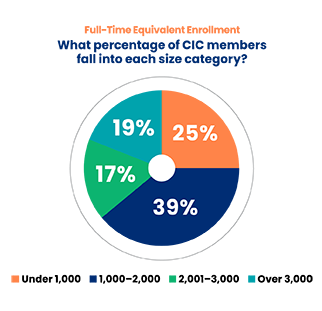
How are CIC members distributed across Carnegie Classifications?
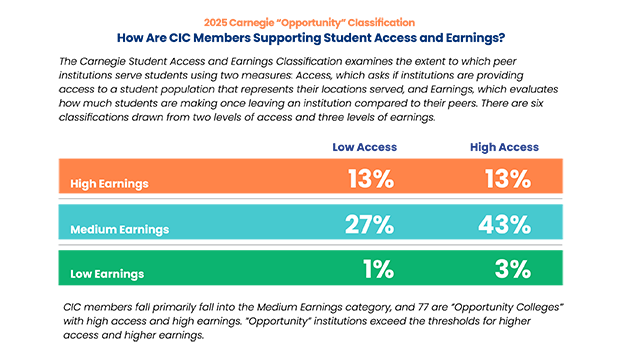
The most recent Carnegie Classifications were released in Spring 2025. CIC members in 2025-26 are represented in most of the 31 descriptive Institutional Classifications which are built on three pillars: award level focus, academic program mix, and size. CIC members fall into many of these categories. The ten classifications with the most members are shown below.
| Mixed: Baccalaureate | 45 |
| Mixed: Undergraduate/Graduate-Master’s Small | 25 |
| Mixed: Undergraduate/Graduate-Doctorate Small | 21 |
| Mixed: Undergraduate/Graduate-Doctorate Medium | 15 |
| Professions-Focused: Baccalaureate Small | 111 |
| Professions-Focused: Undergraduate/Graduate-Master’s Small | 76 |
| Professions-Focused: Undergraduate/Graduate-Master’s Large/Medium | 25 |
| Professions-Focused: Undergraduate/Graduate-Doctorate Small | 48 |
| Professions-Focused: Undergraduate/Graduate-Doctorate Medium | 61 |
| Special Focus: Arts and Sciences | 125 |
| Special Focus: Nursing | 19 |
| Special Focus: Other Health Professions | 18 |
| Other Institutional Classification | 42 |
Annual CIC Institutes
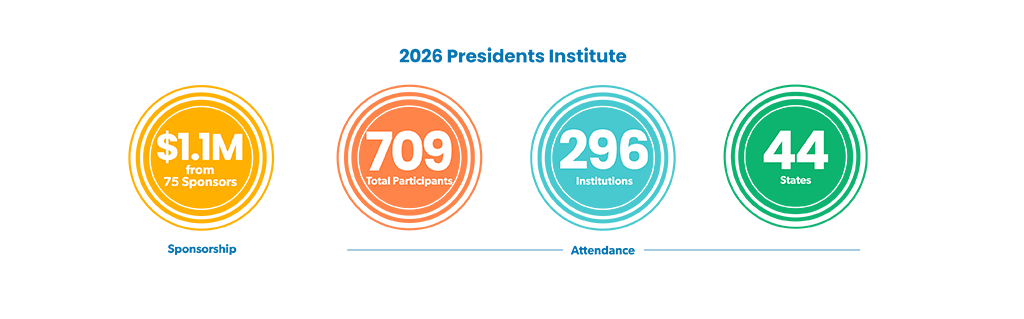
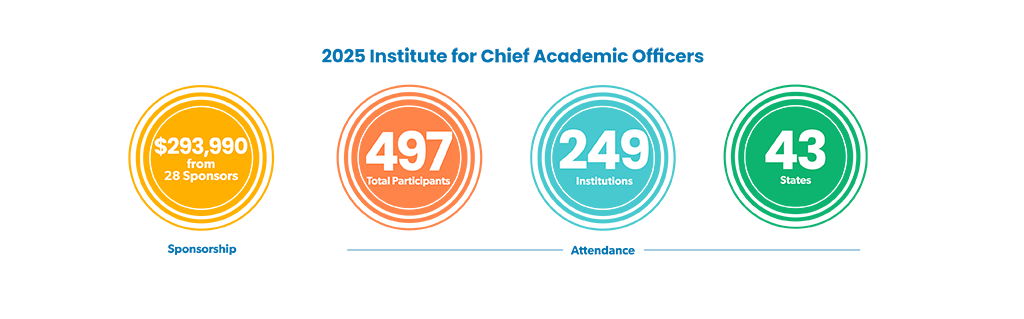
CIC’s signature events serve as premier annual convenings that strengthen leadership across independent higher education. The Presidents Institute is one of the largest annual meetings of college and university presidents, while the Institute for Chief Academic Officers represents one of the nation’s largest gatherings of provosts and academic affairs leaders. Leaders from CIC member institutions and affiliate organizations gathered in January for the 2026 Presidents Institute in Orlando, FL, and in November for the 2025 Institute for Chief Academic Officers in Indianapolis, IN. Both Institutes provided participants an opportunity to think creatively in a community and return to their campuses with new inspiration, innovative solutions, and deeper professional relationships.
2026 Presidents Institute
This year’s theme was A Deeper Purpose, and participants explored strategies that empower campuses to fulfill their missions and remain resolute in serving the common good. Plenary panels explored the future of the academic social contract, campus cultures of resilience, identity and pluralism in the current landscape of higher education, and the federal policy agenda. Concurrent, discussion, and interactive sessions—whose content is overwhelmingly derived from presidential proposals and feedback—provided peer wisdom on board relations, finances, partnerships and mergers, accreditation, artificial intelligence, legal and political issues, and media relations.
Highly Engaged Sessions
- Building a Resilient Campus Culture
- Identity, Pluralism, and the Current Landscape of Higher Education
- The Academic Social Contract
- The Policy Agenda for Independent Higher Education
- The Shifting Landscape: A CIC Partnership and Mergers Project Conversation
- Using AI to Maximize Your Efficiency as President
- Open Conversations on Presidential Challenges and Concerns
- What Does an AI Ready Campus Look Like?
- Is Your Facemask On? Building a Resilient Leadership Team
- Legal Issues that Keep Presidents Up at Night
2025 Institute for Chief Academic Officers and Their Teams
This year’s theme was Building Places of Promise: Unlocking Student Success, and programming focused on uniting around foundational values—mission, passion, and purpose—to create student-centered environments where students can thrive through resilience and belonging. This year, the invited roles included chief academic officers; chief student affairs officers; chief student success officers; chief diversity officers; belonging, inclusion, and culture officers; teaching and learning center professionals; career services professionals; and academic affairs team members. Topics for interactive seminars and concurrent sessions included navigating academic freedom, managing campus conflict, preparing students for meaningful careers, integrating AI on campus, campus free expression, civil discourse, student success, legal issues surrounding higher education, and sustaining wellness.
Highly Engaged Sessions
- Moral Courage: A Skill Set for Campus Unity—Without Uniformity
- Four Keys to Delivering a Holistic and Transformational Student Experience
- The Power of We: Collaboration for Student Success
- Moral Courage Immersive
- Retention Revolution: No More Silos!
- AI in Action: Practical Implementation for Institutional Leadership
- Humane Leadership in Hard Times: Faculty Governance and Academic Change
- The Art/Arc of Being Provost
- Leading with Joy in Uncertain Times: Wellness, Boundaries, and Bold Leadership
- Introducing the New KIT and FIT—Interactive Benchmarking for Institutional Analysis and Strategy
CIC Development Program Highlights
Leadership Development Programs
- Belonging and Academic Leadership Initiative
- Executive Leadership Academy
- Faculty Leadership Academy
- New Presidents Program
- President-Board Convening on Inclusive Leadership
- Presidential Renewal Program
- Presidential Spouses and Partners Program
- Presidential Vocation and Institutional Mission
- Presidents Circles
- Senior Leadership Academy
Faculty Development Programs
- Deans Coaching Circles
- Funding the Future Workshops
- Teaching Interfaith Understanding
- Workshop for Department and Division Chairs
Institutional Development Programs
- Campus Free Expression Project
- Legacies of American Slavery: Reckoning with the Past
- National Career Center Design Workshop
- Ohio Consortium for Transfer Pathways to the Liberal Arts
- Partnerships and Mergers Project
- Texas Work-Based Learning Consortium
- Work-Based Learning Consortium
Research and Resources
On Campus Book Series
The On Campus book series amplifies the voices and expertise of CIC member leaders while providing the broader higher education community with practical, accessible insights on the most pressing challenges facing independent institutions today.
In Fall 2025, CIC reached an agreement with Anthem Press to produce the On Campus book series. Books in the series will address significant issues in higher education from the perspective of current campus leaders. The short volumes are designed to be accessible for a general audience, and aim to clarify current issues, problems, concepts, controversies, and strategic successes from informed points of view. CIC’s senior advisor Grant Cornwell serves as the series editor, and the series is supported by an advisory board made up of CIC presidents and higher education leaders. Initial volumes on research; diversity, equity, and inclusion; finances; artificial intelligence; free expression; and small college innovations are already in production.
CIC Insights Tool
After more than 20 years of providing the Key Indicators Tool (KIT) and Financial Indicators Tool (FIT) to support member institutions, CIC listened carefully to member needs and reimagined these essential resources as the CIC Insights Tool—a more flexible, interactive solution that puts institutions in control of their own benchmarking.
The goals of the CIC Insights Tool are to provide benchmarking information to each member institution to understand institution metrics compared to self-curated peers, to prioritize areas for attention and set targets, and to communicate findings with key stakeholders across campus. As a free resource for members, the tool exemplifies CIC’s commitment to evolving offerings based on what matters most to the institutions we serve. The data is retrieved from the U.S. Department of Education Integrated Postsecondary Education Data System (IPEDS) data by UQ Solutions. The 2026 reports were provided to member institutions in February 2026. The CIC Insights Tool allows member institutions to curate their own comparison groups and provides summary pages along with the traditional layout of the legacy KIT and FIT.
Digest of Recent Research
CIC published the final issue of the online Digest of Recent Research in Autumn 2025. Published from 2016 to 2025, the Digest highlighted timely and pertinent research for presidents and senior campus leaders, releasing two issues per year. The final issue included digests of articles and books as well as links to resources and informational portals addressing the theme of faculty and staff wellbeing.
- Funding Source and Amount: $90,000 from the Arthur Vining Davis Foundations
- Special Information: The final issues of the Digest were edited by Bethany L. Miller, associate provost and chief data officer at Macalester College (MN), and Philip T. Dunwoody, social sciences division head and professor of psychology at Juniata College (PA). Under this editorial oversight, each issue shared research and resources on a theme. All issues of Digest of Recent Research are available on the CIC website.
Economic Impact Reports
In partnership with Ingram Market Analytics, CIC offered a virtual workshop on the development of an Economic Impact Report, including a set of resources members can use to create a one- to two-page infographic for use in demonstrating the economic value of institutions to their communities. Offered in June 2026, 146 individuals attended the four-hour workshop. A recording and supplemental materials are available on the CIC website.
Independent Newsletter
After discussion with board members on CIC’s communications committee in January 2026, staff decided to pause publication of the Independent newsletter—a resource dating back to 1956—to evaluate how members engage with its digital editions in an evolving communications landscape.
While the newsletter provides comprehensive coverage of CIC programs, leadership development opportunities, and member institution highlights, CIC recognizes that many members now receive their organizational updates primarily through social media channels and email communications. This assessment will help CIC determine how best to deliver value to member audiences who need tailored, accessible information about the tangible benefits and community-building opportunities CIC offers. Issues from 2021 to 2026 of the Independent newsletter can be found online.
The Winter 2026 edition spotlights CIC’s flagship leadership development programs—the 2026 Presidents Institute (themed A Deeper Purpose) and the 2025 Institute for Chief Academic Officers (themed Building Places of Promise: Unlocking Student Success)—along with updates from CIC networks and member institutions.
The Summer 2025 edition features highlights from new CIC initiatives including the Alliance for Strategic Innovation and results from the membership survey. The issue also covers updates from key CIC networks such as NetVUE, AI Ready, and the Online Course Sharing Consortium, along with coverage of summer leadership development programs and seminars. Member institution updates showcase innovation happening across the independent higher education sector.
Solution Center
The Solution Center marketplace is a dynamic platform built for the CIC community and designed to help independent colleges and universities find tailored solutions, services, and products on one platform. Managed by CIC, the marketplace connects institutions to companies and consultants dedicated to the independent higher education sector, free of charge. Browse by category, submit RFPs, and review real feedback from peer institutions—all in one place. As of June 2026, there are more than 70 different categories to search and connect with more than 600 suppliers.
Webinars
- “State of the Sector” was held on September 15, 2025. Led by CIC President Marjorie Hass, the webinar addressed a variety of challenges facing higher education and outlined several new CIC programs designed to help navigate current issues and actively seek new ways to support the sector. The discussion was moderated by CIC Vice President of Membership Engagement Jeff Woods.
- “The Compact for Academic Excellence: What’s at Stake for Independent Colleges and Universities” was held on October 30, 2025. Following President Donald Trump’s offer to sign on to the administration’s Compact for Academic Excellence to nine universities and then to all U.S. colleges and universities, CIC offered a special webinar to provide perspective and advice for navigating the decisive moment. CIC’s Marjorie Hass and Jacqueline Pfeffer Merrill, senior director of civic learning and free expression projects, presented with attorney Jim Newberry of Steptoe and Johnson PLLC to discuss the compact’s implications for admissions, enrollment, paths to graduation, institutional autonomy, shared governance, free expression, and legal standing.
- “The Landscape of Graduate Education” was held on March 30, 2026. CIC institutions with a tradition of serving undergraduate students increasingly offer graduate programs as well, which can present new challenges in everything from business models to student support. This webinar included a data-informed overview of the state of graduate education and a conversation about “mission and money” as motivations for new graduate programs. The webinar also included a preview of the new CIC Graduate Program Network. The presenters were Robert Kelchen, chair of the Department of Educational Leadership and Policy Studies, University of Tennessee, Knoxville; Kerry Fulcher, president, Point Loma Nazarene University (CA); Sarah M. Ferguson, vice president for strategic initiatives and partnerships, Texas Lutheran University; and Philip M. Katz, CIC senior director of projects.
- “Partnering to Fill the Student Loan Gap” was held on April 23, 2026. With news that in July 2026, graduate and professional students would no longer be able to take out Federal Direct Graduate PLUS loans, and annual limits of $20,500 for general graduate students and $50,000 for professional students would be set for unsubsidized direct loans along with new lifetime caps for borrowers, this webinar helped CIC institutions think about how to fill the gap. The focus was on nonprofit and state-based higher education finance organizations partnering with higher education institutions to provide alternative plans for paying for college. The discussion was led by Rachelle Keck, president, Grand View University (IA); Amy Novak, president, St. Ambrose University (IA); Steve McCullough, president/CEO, Iowa Student Loan Liquidity Corporation; and Gail daMota, president, Education Finance Council.
Listservs
The listservs embody CIC’s core pillar of “connection” by building durable networks among members and facilitating the exchange of ideas and resources at no additional cost. By creating trusted, confidential spaces exclusively for CIC member employees, the listservs strengthen leaders, support institutional growth, and bolster resilience through peer-to-peer collaboration.
This free benefit demonstrates CIC’s commitment to delivering value not only in ROI but also in differentiation and mission support: connecting professionals across independent colleges and universities who face similar challenges and opportunities. Through these communities, CIC amplifies the collective expertise of its membership, turning shared experiences into actionable solutions.
Campus Role Listservs
- Presidents Listserv
- CAO Listserv
- Advancement Listserv
- Chairs Listserv
- Chiefs of Staff Listserv
- Data Listserv
- Deans Listserv
- Enrollment Listserv
- Finance Listserv
- HR Listserv
- Inclusion Listserv
- PR Listserv
- Presidential Assistant Listserv
- Presidential Spouse Listserv
- Registrars Listserv
- Student Affairs Listserv
Network Listservs
- Belong Community Listserv
- NetVUE Listserv
- State Councils Listserv
- Tuition Exchange Program Listserv
Social Media
- LinkedIn: Council of Independent Colleges (10,031 followers as of July 31, 2026)
- X: @CICnotes (2,391 followers as of June 2026)
- Bluesky: @cicnotes (175 followers as of June 2026)
Letters to Government Officials and Amicus Briefs
While CIC does not engage in formal lobbying efforts, CIC routinely lends its support to allied associations and organizations who lead those efforts. Since the summer of 2025, CIC has signed on to four amicus briefs and 17 letters. These encompass the breadth of pressing issues facing independent higher education in this moment, including: accreditation, student financial aid, and the definition of a professional degree.
- Briefs: 4
- Letters: 17