

2026 Conference Reflections
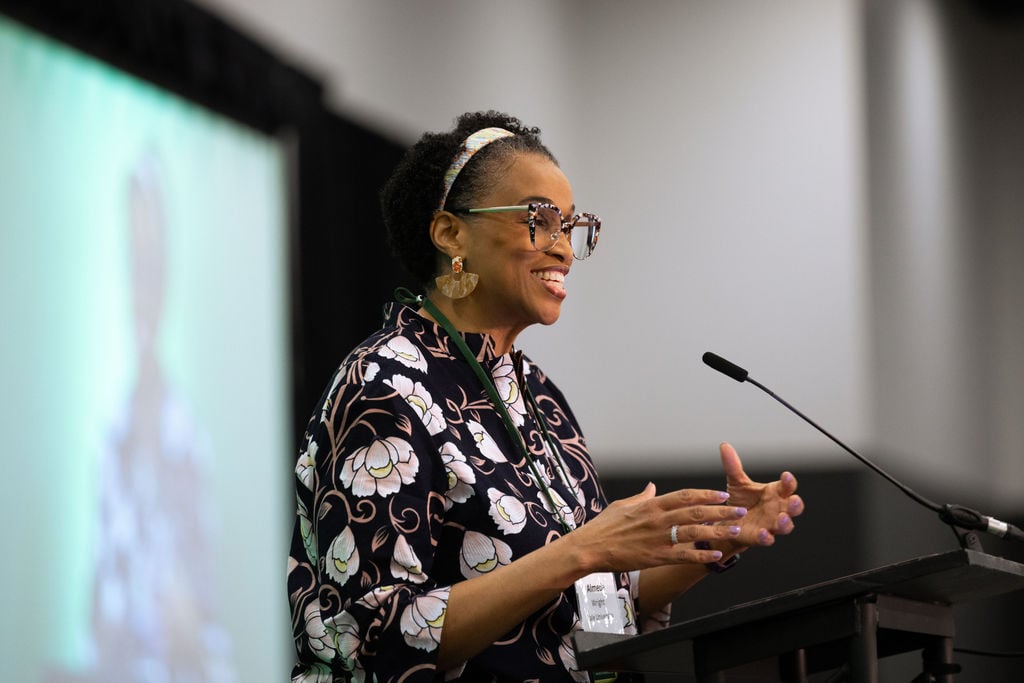
Keynote Closing Plenary Session: Almeda Wright
By Krista Hughes, NetVUE Director of Resource Development
Where do higher education professionals find hope in these perilous times? This question framed Almeda M. Wright’s closing keynote address. To explore it, she took the audience on a journey into U.S. history to engage with three models of educating-with-hope under challenging (and frequently risky) circumstances. Wright invited her audience to consider the lives of three Black activist-educators who lived out steady, persistent callings that proved to be quietly revolutionary: W.E.B. Du Bois, Anna Julia Cooper, and Septima Poinsette Clark.
While better known for his work as a sociologist, Du Bois was also a thoughtful educator. As an undergraduate student at Fisk University, he ventured into rural Tennessee to teach children in small communities that otherwise had little access to education. He was surprised to be on the receiving end of hospitality and, in turn, to learn quite a bit about communities and realities he had previously ignored or underestimated.
Similarly, Anna Julia Cooper taught racially and economically marginalized children and, by extension, their families. She advocated for the power of language development and communication as not just basic skills, but vital elements of personal formation, socialization, and access to a wider world. Her work as an educator took seriously her students’ webs of relation: to teach a child was to teach families and even generations.
Years later, Septima Clark, a South Carolina educator, emphasized the civic purposes of education. She saw education as a key to citizenship—something her students, along with their families and communities, did not officially possess. Clark, Wright said, employed a long-term strategy that was pragmatic, improvisational, and communal. She focused on civic knowledge and skills and proactively placed trust in the people to understand what they most needed for themselves and, once equipped, to pursue it.
From these examples, Wright called upon conference participants to approach their own educational work in accord with the following dispositions: “Be ordinary. Be local. Be committed.” Alongside this counsel, four key insights emerged.
“Crisis times” are not new. In response to a question during Q&A about how to weather the cascading crises facing higher education and other socio-cultural institutions, Wright noted that our current time “does not have the market on crisis. There have always been crises.” Du Bois, Cooper, and Clark are all models of “persistence through peril”; hence the relevance of their stories for today. Amidst a different set of challenging circumstances, how might educators translate the wisdom they model?
Radical change is often ordinary, quiet, and slow. Particularly in the cases of Cooper and Clark, the full scope of their impact as educators took decades to develop. Steady and persistent, they worked despite fierce resistance from outside forces and generally poor odds. Today, in a world and an industry that emphasize speed, urgency, and short timeframes, what individual and collective practices might educators implement that would encourage ourselves and our students both to slow down—if only for a few moments—and to take a longer view?
Educators committed to the long haul adapt, learn, grow, and evolve. This is perhaps what activist Mariame Kaba means when she says, “Hope is a discipline,” not a feeling. How can educators work together to create the conditions for adaptation and our own growth—as a practice of hope and resilience and as a countermovement to destructive forces in the wider world?
Impact exceeds metrics. All three activist-educators gradually gained an appreciation of how influential their work was. No one is an island, as John Donne reminds us; our students’ education impacts not only them, but those around them. Likewise, education bears fruit beyond the current moment, and educators rarely know their full impact. While assessment metrics can provide meaningful insight into what we are doing well and what needs improvement, genuine impact spills beyond official measures. How might this awareness encourage and enliven us?
Back to Top
To report a technical problem with the website, or to offer suggestions for navigation and content issues, please contact Madeline Smanik, NetVUE communications specialist, at msmanik@cic.edu.