


2026 Conference Reflections
Bobby Fong Memorial Keynote Address: Norman Wirzba
By Kari Kloos, NetVUE Grant Program Officer
The 2026 NetVUE Conference convened with the theme “Vocation: An Itinerary of Hope.” Given our current moment of global uncertainty, this focus might either give us much-needed relief or feel like an abstract exercise. The opening keynote speaker, Norman Wirzba of Duke University (NC), admitted at the outset that he might only say the word hope once in his talk (thereby concluding his discussion of the word), yet what followed was a profound vision for a more hopeful and sustaining engagement with students, communities, and our world. Nearly every higher education think piece describes the challenges that the sector is facing: enrollment declines, the exponential growth of generative AI, shifting federal and state financial aid budgets, and revenue shortfalls. Wirzba reframed the current landscape by asking the audience: what is this all for? While he asked this question of students who restlessly pursue achievements to add to their resumes, he could as easily have described the very work of universities themselves.
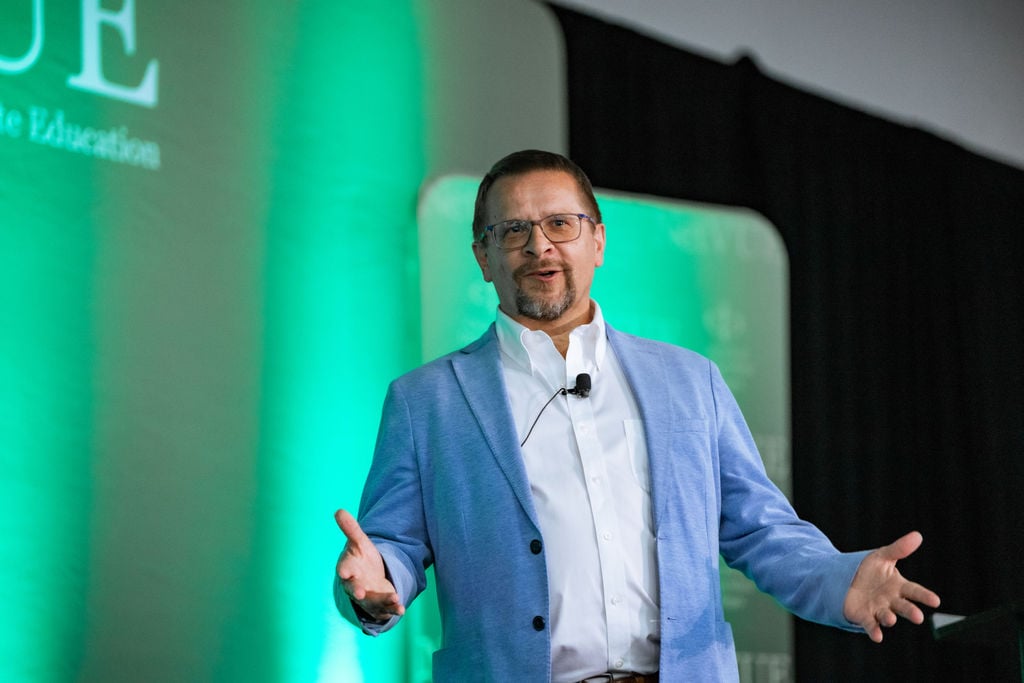
Wirzba’s main points were simple and invitational. Place matters, because it positions you to see in certain ways. We live with the land that nurtures us, he noted, with plants and animals as kin. Everything, made as it is of soil and divine breath (as in the creation narrative in Genesis 2), is sacred and beautiful, from fresh raspberries to the sound of a baby giggling.
Yet too often we fail to see this sacred beauty, which Wirzba attributed to a “lingering deficit disorder.” We look at the world and objectify it instead of experiencing it. We work without pausing to rest and enjoy the world around us. In this context, Wirzba called the audience to value sensuous intelligence—engaging the world through the full experiences of the senses—and sabbath rest as the climax and fulfillment of existence. In this vision, vocation is a map to hope precisely by reminding us that we labor not primarily for the accumulation of wealth, prestige, or even service for its own sake, but for the sake of being in right relationship with creation and with community.
What might this vision mean for NetVUE institutions? What would it look like to value sensuous intelligence and to practice sabbath? How would doing so engage vocation as an “itinerary of hope”? As I reflect on the talk, what captures my imagination most is Wirzba’s understanding of sabbath as the answer to the question, what is this all for? Both simple and incisive, this vision of sabbath cuts through the layers of artifice that construct human lives and institutions, as well as their measures of success. Most fundamentally, sabbath involves the enjoyment of things in a reciprocal, loving dynamic of giving and receiving. If, in our labors to promote vocation in undergraduate education, we can’t answer the question of “what is this all for?” in a way that affirms such enjoyment, do we need to reconsider what we are doing in the first place?
I am also struck that sabbath as enjoyment of the world around us does not require major initiatives, strategic plans, or new funding. Rather, it is choosing to savor the places we inhabit with the people we engage.
There are myriad reasons why sabbath as restful enjoyment is compelling: from the increase in mental health issues associated with excessive screen time, to climate anxiety, to the epidemic of loneliness that is especially acute among young adults. From the perspective of vocation, sabbath offers something tangible in the present moment. It is not about what we are called to do someday, after getting the degree, starting the career path, or building a family. Instead, it calls us to be present now (as well as later in life). I worry sometimes that the ways I teach vocational exploration and discernment might tend to over-emphasize the future. What if I also asked students to engage their surroundings now with rest and enjoyment? What might they learn? Might this sensuous intelligence break through vocational inertia and anxiety, providing something tangible to build upon? I wonder if such experiences might be gratifying in a deeper sense: conveying grace.
Wisely, Wirzba did not give a prescription for how to do this. Rather, he emphasized that our efforts will be experimental and improvisational. He suggested starting small and eating together—things we can do especially in the hard times to remind ourselves what all of this is for.
Back to Top
To report a technical problem with the website, or to offer suggestions for navigation and content issues, please contact Madeline Smanik, NetVUE communications specialist, at msmanik@cic.edu.