



2026 Conference Reflections
Concurrent Workshops: Central Themes Addressed by Colleagues from Across the Network
Concurrent workshops often feature a team of presenters who work at different institutions but have something common to share on a specific issue. This year, some of the workshops focused on career and internships, the changing roles of chaplains, maximizing impact in vocational programming, and many more. In this article NetVUE staff members Rachael Pickett and Geoffrey Bateman each share their reflections on two of the eight concurrent workshops: the first explores how vocation and character scholarship can enhance one another, and the second on important recommendations when implementing vocational reflection into the first-year experience.
Character & Vocation: Intersecting Spheres of Hope
By Rachel Pickett, NetVUE Webinar Coordinator
In this workshop, four institutions shared innovative approaches to integrating character education, vocational discernment, and mission-driven education—three interconnected pillars that together foster student flourishing for the common good. All of the presenters have sought support and funding from NetVUE as well as the Educating Character Initiative (ECI) at Wake Forest University (NC).
Character education emphasizes virtue formation through intellectual and moral development, drawing on frameworks like Michael Lamb’s seven strategies (2021): habit through practice, personal reflection, study of virtuous exemplars, development of virtue literacy, awareness of bias and context, moral reminders, and mutual friendships. Vocational discernment emphasizes lifelong exploration of calling within community contexts and developing a sense of purpose. Mission-driven education prioritizes whole-person development, values integration, and community engagement. These elements converge to create transformative educational experiences.
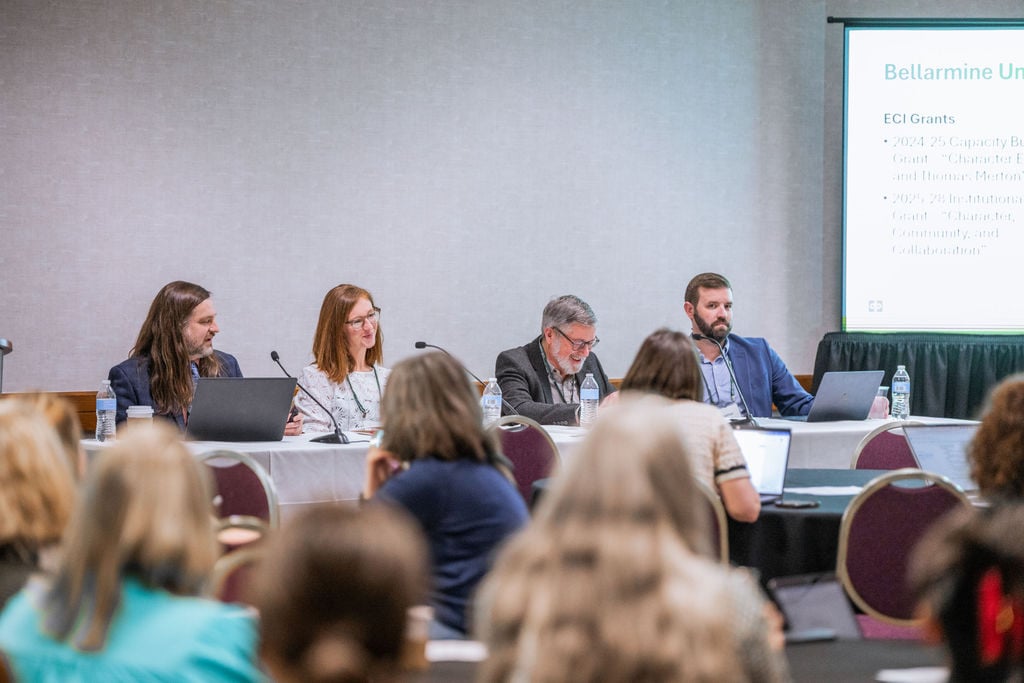
Anne Funke of University of Dubuque (IA) shared how the institution has developed a comprehensive character framework centered on four pursuits—knowledge, wellbeing, community, and service—establishing new institutional goals that position vocation as a calling toward moral character development. Their approach emphasizes faculty collaboration and student outreach to build sustainable communities of practice.
Jonathan Blandford of Bellarmine University (KY) focused on faculty development and a wholistic advising model. Bellarmine draws inspiration from Thomas Merton’s vision of community-engaged work, exploring connections between his philosophy and character education. Their character and mission work overlaps in communities of practice, exemplified by exploring Black Catholic history in Louisville. Their institutional discernment model creates communities of accountability.
King University (TN) was represented by Glenn E. Sanders, who discussed how King University cultivates thoughtfulness, resourcefulness, and responsibility through their character grant initiatives, hosting scholars like Michael Lamb and Paul Wadell. They frame the intersection simply: character is “who we are” while vocation is “what we do.” Their annual Festival of Character celebrates this work, with athletic teams serving as character development communities.
Nathan Webb of Belmont University (TN) presented on the dual grant initiatives: the ECI Institutional Impact Grant focusing on shared vocabulary, curricular integration, and character networks; and NetVUE’s Vocation Across the Academy grant program, emphasizing vocation-character integration through cohort-based faculty development.
The common themes that emerged across institutions include the critical role of community in supporting initiatives, challenges in sustaining programs beyond grant funding, varied understanding of character and vocation terminology among the university community, and institutionalization of the projects. Assessment strategies may include questionnaires, discipline-specific virtue identification, and qualitative student narratives. Faculty emphasized connecting character to professional skills, practicing vulnerability alongside students, and providing intentional counter-narratives to prevailing social messages. Students demonstrate genuine interest in these conversations, underscoring the importance of building communities that enable deep reflection and meaningful dialogue in today’s challenging world.
The Prospects and Perils of Vocation in First-Year Programming
By Geoffrey Bateman, NetVUE Blog Editor
To frame this session, Cynthia Wells of Messiah University (PA) started by encouraging participants to consider the big picture of their institutions as they engaged the session’s focus on best practices of integrating vocation into first-year programming. What works on any given campus depends greatly on its institutional context; it can be helpful to tether this work to larger strategic priorities and consider first-year experience programs as an imaginative space for students and a site for concrete practice. In addition to Wells, the session featured Michelle Steffenhagen of Bethel University (MN) and Ryan White of Hope College (MI).
The panel reminded participants that—as with all vocational programming—everyone needs to be intentional and focus on what they hope to achieve by integrating vocation into the first year. Given the many demands and distractions that first-year students face as they begin college, the presenters cautioned us from trying to do too much; instead, they provided a framework to generate meaningful activities appropriate for first-year students as they begin their vocational journeys in higher education.
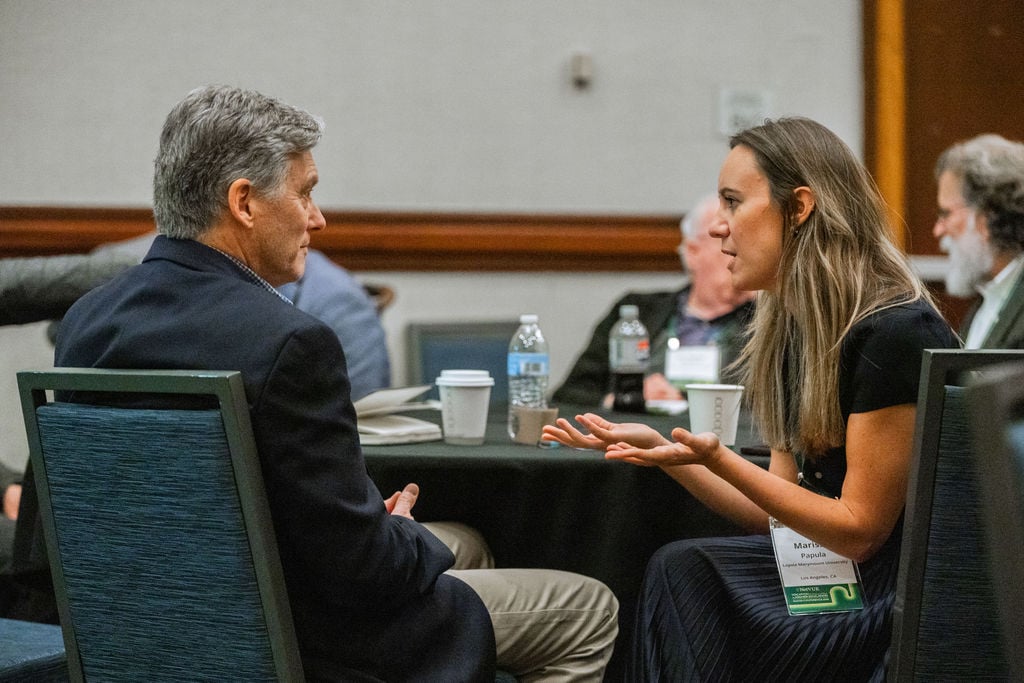
The presenters offered three strategic priorities to help guide this work and create effective first-year vocational programming—initiatives they characterized as introductory, exploratory, and habit-based. They recommended that first-year vocational programming focus on planting the seeds of vocational thinking and introducing students to vocation as it is understood and expressed in their own institutional contexts. Then, presenters highlighted exploratory practices that engage first-year students in reflections and conversations about themselves to increase self-awareness as they begin to consider their callings, with an emphasis on their calling to be an undergraduate student. Finally, Wells, Steffenhagen, and White suggested prioritizing habit-based practices that help students build the skills that allow them to begin to explore and discern their vocations, skills that largely focus on identifying and practicing daily routines that increase attentiveness and self-reflection.
The presentation was anchored by examples from three institutions—Dominican University (IL), Methodist University (NC), and Hope College (MI)—to illustrate these best practices. As well, they shared this document with numerous questions to prompt further reflection and discussion along with a mapping activity to help participants situate their first-year vocational programming within a four-year arc. Overall, the session provided important insights into how to adapt and scaffold approaches to vocational exploration that are appropriate to first-year students and prepare them for deeper and more sustained reflection and action as they progress through their degrees.
Back to Top
To report a technical problem with the website, or to offer suggestions for navigation and content issues, please contact Madeline Smanik, NetVUE communications specialist, at msmanik@cic.edu.
To report a technical problem with the website, or to offer suggestions for navigation and content issues, please contact Madeline Smanik, NetVUE communications specialist, at msmanik@cic.edu.