


Reviewed by Hannah Adams Ingram
College Chaplain and Associate Dean for Institutional Equity at Macalester College

Like many in my professional networks, I often find myself dancing in the tension between two aspects of spiritual practices. On the one hand, these practices can—in some cases—admittedly verge on cultural appropriation. On the other hand, they can also serve as a gateway for folks to consider spirituality as an important part of their lives. As a college chaplain embedded in a division for institutional equity on a campus with significant religious diversity (including those who would describe themselves as non-religious), I was thrilled to hear about Liz Bucar’s first trade book, Beyond Wellness: How Restoring the Religious Roots of Spiritual Practices Can Heal Us.
Bucar begins with this problem: we in the West often treat spiritual practices as a “spiritual salad bar,” picking and choosing as we go. In doing so, we’re missing out on the depth that religious traditions give these practices. A professor of religion at Northeastern University, Bucar reveals early in the book that she herself is not affiliated with a religious tradition, which establishes credibility for her project. I couldn’t help but worry, even as a minister myself, that a religiously-affiliated author might come across as sanctimonious when encouraging readers to explore the religious roots of popular wellness activities.
Bucar sets out on a journey to experience several practices that have religious connections but have been stripped of them in Western society for the sake of making them accessible for all. In each chapter, Bucar shares her experience researching these practices, describes the religious history of each one, and invites readers to wonder with her whether integrating the practice’s intention with the practice itself could bear transformative fruit. Our students are seeking meaning in a variety of places, and many of these wellness practices have served as exploratory entry points. What is compelling about Bucar’s argument, particularly in the context of higher education, is the suggestion that people might derive more meaning from these experiences if they were to understand the religious roots of these practices more fully.
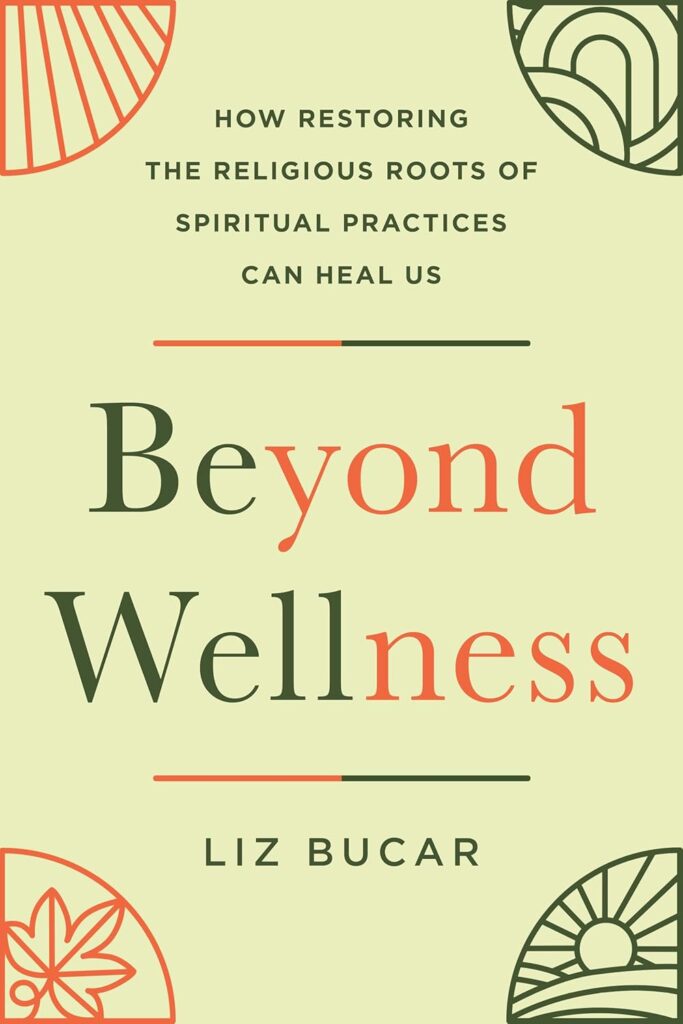
The author covers both expected and unexpected practices in seven chapters: yoga, mindfulness, Alcoholics Anonymous, eating practices, fitness culture, listening practices, and psychedelics. The book is accessible for a popular audience, but is academically grounded. This means that it can evoke genuine engagement among undergraduates while still encouraging educators to explore these texts—across disciplines and educational backgrounds—and to meet one another in enriching conversations. Members of our campus communities are seeking meaning in a variety of places; hence, for NetVUE readers, I would recommend considering this book for the following:
- Undergraduate classes about spirituality or as a contemporary addition to an introduction of religion course—this text has so many relevant examples that raise important questions for students to consider in these kinds of courses.
- Faculty and staff groups seeking meaning from spiritual practice—this book is a relatively quick and accessible read that invites stories about one’s own search for meaning. I think there are many people on our campuses who would welcome this conversation.
- Background reading for chaplains and campus ministers—I feel more equipped to engage with students seeking meaning across institutional lines after reading this book. As a trained spiritual director, this book asks me to keep trying to be accountable to the traditions that have anchored so many throughout history, even while allowing space for newness and flexibility.
Bucar’s book brings up important concerns of safety, abuse, colonialism, and unmoored living. It is an introductory text in the sense that she analyzes these topics only briefly; still, I am thankful for an accessible volume to share with folks about topics I have privately worried about as a spiritual caregiver. Our campuses are exploring spiritual practices in pursuit of wellness, and this pursuit is a natural opening for conversations about meaning-making. Beyond Wellness invites us all into this process by fostering deeper understanding of the spiritual ground many students are—often unknowingly—standing upon.

To report a technical problem with the website, or to offer suggestions for navigation and content issues, please contact Madeline Smanik, NetVUE communications specialist, at msmanik@cic.edu.