



Reviewed by Daniel Meyers
NetVUE Online Community Coordinator

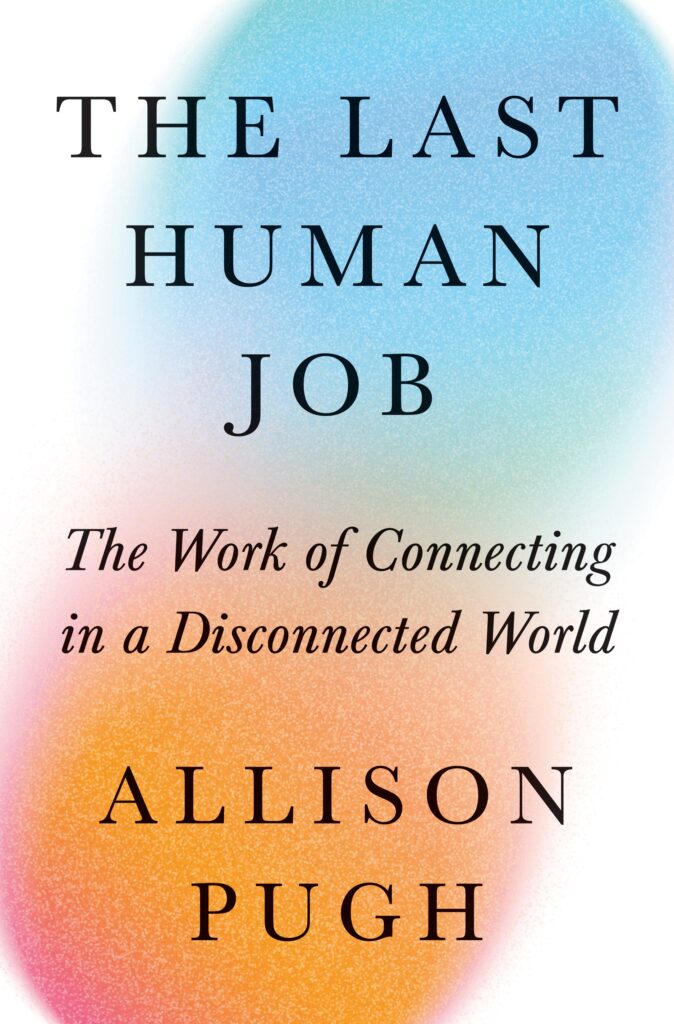
Allison Pugh’s The Last Human Job: The Work of Connecting in a Disconnected World gives readers a new way to describe familiar, but often overlooked, forms of human work. Drawing on more than 100 interviews—with therapists, physicians, teachers, chaplains, hairdressers, community organizers, and workers from several other occupations—Pugh introduces readers to the concept of connective labor. She defines this term as “the reflective work that people do to convey an emotional understanding of the other,” which includes listening well, communicating empathy, honoring dignity, inviting vulnerability, and creating connection and resonance. As generative AI continues to evolve and impact the workplace, Pugh argues that AI cannot replace the distinct human capacity for this kind of connective labor. In fact, she examines how this term helps us distinguish some forms of human work from other kinds—especially those forms that disconnect individuals, such as automation and the reliance on mass data for decisions. For educators who guide college students in vocational exploration, Pugh offers valuable tools to help students reflect on professional skill development, evaluate future employers, and deepen conversations about meaning.
Connective labor requires skills that cannot be engineered out of human hands. Although generative AI can interact with humans in sophisticated ways, Pugh argues that in settings like classrooms, hospital rooms, or funeral homes, the embodied work of a human being cannot be replaced by a bot’s frictionless response. As undergraduate students move through their degrees and consider their relevance in the workforce, educators have an opportunity to ask them what kind of connective contributions they might want to make to and through their chosen professions. Pugh identifies five skills that are common among those who excel at connective labor: using the body, reading and deploying emotions, collaborating, managing spontaneity, and making and responding to mistakes. These capacities are valuable and learnable—even though they rarely appear on a transcript—and Pugh points insightfully to the skills that educators might encourage their students to build while they are in college.
Developing these reflective and emotional skills is only part of the puzzle; employees also need a work environment that values these skills. Pugh’s idea of social architecture describes the organizational ecosystem that either supports or devalues connective labor. Strong social architecture prioritizes relationships—especially mentorship—sometimes over productivity. It also establishes values, norms, rituals, and cultures that recognize connective labor and its nonquantifiable dimensions. Finally, it protects resources—such as the guarded time needed to pay full attention to others—that are required to do this work well. A well-designed social architecture encourages employees to maintain their boundaries and fosters a culture that recognizes the value of this work. Pugh’s discussion of this concept provides students with a practical framework to assess future employers and graduate education programs. As they make decisions about their future, they can use Pugh’s insights to ask a question like this one: “Will this organization nurture and value the kind of labor I want to do?”
In addition to these practical ideas for student discernment, The Last Human Job explores questions of meaning much more broadly. Even though Pugh does not clearly define meaningful work in the context of AI, she does discuss several ways AI could undermine it. For example, as organizations develop their abilities to make decisions based on increasingly sophisticated data, the results of their work could ignore or even diminish meaningful emotional intelligence. Alternatively, if the workplace prioritizes connective labor and emotional resonance as Pugh hopes, workers could struggle with the sustained presence and vulnerability that this kind of work requires, leading to a “numbing” effect. As Pugh discusses these kinds of tensions, she offers several deeper questions: Does meaningful work depend on expertise, human need, or both? Does a meaningful contribution serve as many people as possible, or serve fewer people with greater connection? Must meaningful work involve “performing” human capacities that machines cannot replicate? If so, how do workers cultivate those capacities in a sustainable way? And if AI “frees” humans from menial tasks, so they can pursue more meaningful work, who decides what counts as menial and what counts as meaningful?

NetVUE colleagues can also apply these insights to their own context. Pugh’s discussion of social architecture lends itself to critical conversations about institutions of higher education. Overall, Pugh invites readers to consider questions about AI that are grounded in the enduring value of human capacities, as well as the possibility that institutions might more fully recognize the often-unseen human connection in certain work. Optimistically, The Last Human Job asks readers how they might advance certain values—values that likely resonate strongly with readers who work at NetVUE institutions—such as cultivating understanding, connection, and meaning with others.
To report a technical problem with the website, or to offer suggestions for navigation and content issues, please contact Madeline Smanik, NetVUE communications specialist, at msmanik@cic.edu.