


NetVUE Conversation Cards: Myths and Misconceptions
By Krista Hughes, NetVUE Director of Resource Development
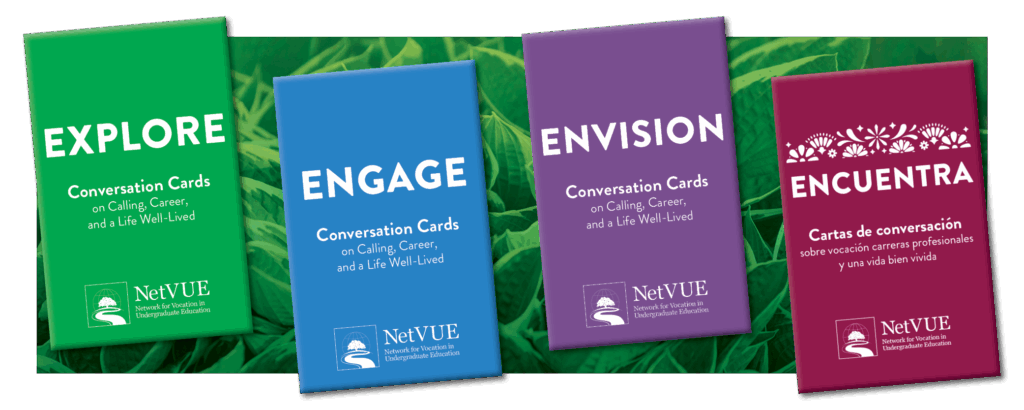
NetVUE Conversation Cards are one of NetVUE’s most popular ready-to-use resources. But how well do you know their ins and outs—and is your campus using them as effectively or as widely as it could be?
Here are some misconceptions that can get in the way of using them to their fullest potential.
Misconception #1: Only certain people on campus can use the cards.
All the decks were carefully designed to address a range of vocation-related themes and to adapt to a variety of contexts. From advising sessions and classroom teaching to peer mentoring and professional development—and beyond—the conversation cards are highly adaptable. Any interested campus professional can find ways to use them.
Misconception #2: The cards are mostly for ice breakers.
With a little bit of creativity and forethought, educators can use the cards in a variety of ways for a variety of purposes: not just as ice breakers, but for writing prompts, team and community building, student leadership development, and retreats—even conversations on what makes for a good vocational question! Visit the NetVUE Conversation Cards webpage for more ideas.
Misconception #3: The Encuentra cards are only for Spanish-speaking students.
The Encuentra cards are bilingual, with all questions in both Spanish and English. While celebrating the gifts of Hispanic/Latine cultures, the deck was designed to invite all students—from any background—to reflect on how culture shapes their sense of self and calling. If your campus uses the other three decks and not Encuentra, you are missing out! Go to the Encuentra deck webpage for more information.
Misconception #4: The green deck is for first-year students, while the purple deck is for seniors and the blue deck is for students in between.
Not quite. Although the green Explore cards work especially well with incoming students because the questions focus on what students bring with them from their past, older students also benefit from looking back to their younger selves. Likewise, while seniors face questions about their post-collegiate future with greater urgency, all students benefit from using the purple Envision cards to look ahead. Depending on your goals, you can mix and match the decks so that students at any stage of their education are looking back, around, and ahead as they practice vocational discernment.
All in all, the conversation cards are an adaptable tool that can be used in a variety of ways, in a variety of contexts, and with a variety of students. To read more about different approaches from five different NetVUE institutions, revisit the NetVUE newsletter spotlight “NetVUE Conversation Cards: A Tour of Applications and Early Impact” from April 2025. For more information about how to order decks and ideas for using them on your campus, visit the NetVUE Conversation Cards website, where you will also find a handy downloadable facilitation guide.
For questions, contact Krista Hughes, NetVUE director of resource development, at khughes@cic.edu. And if you have used the conversation cards on your campus in a unique way, Krista would love to hear from you!
To report a technical problem with the website, or to offer suggestions for navigation and content issues, please contact Madeline Smanik, NetVUE communications specialist, at msmanik@cic.edu.